
Design properties
Company
Vee · Grant
Role
PM & Product Designer
Surfaces
Letter of Intent · Online Form
Platforms
Desktop · Tablet · Mobile
Team
Me, engineering, writing-engine team
Outcome
~1 hr → ~35 min to get ready
Earning an expert’s trust in an AI draft — one application at a time.
Ready in minutes, never in the dark. The counter walks through the last missing details, a highlighted passage is rewritten in place, and the whole letter gets a more formal pass — every change visible, named and reversible.
Grant writes grant applications for nonprofits. It drafts the Letter of Intent, or fills out the funder’s online form, grounded in the organization’s own history and context.
A model can write that draft in seconds. What it can’t do on its own is be trusted with it — the application goes to a funder, under your name, and your funding depends on it. So the question was never “can the AI write it.” It was how do you get an expert to trust a machine-made draft with something this important — and to trust it a little more every time?
My answer was to earn it the way a new colleague does: make the work easy, make it fast, make it good, and never hide what changed. Getting an application ready dropped from about an hour to about 35 minutes.
I stopped asking “is the draft good?” and started asking “would they send it?”
From the Figma file
Every state, designed before it was built.
Empty documents, lost grants, tablet and mobile got the same care as the happy path — the unhappy states are where an expert decides whether to trust the tool.
I set the product direction and designed the workspace from the first AI draft to submission and outcome, alongside engineering and the writing-engine team.
Owned product & design
The strategy and the whole workspace.
Designed the trust model
How an AI draft becomes something an expert is willing to send.
Sketched, tested, refined
Flows to high fidelity, shaped around how people actually review.
Aligned across the team
With engineering and the writing-engine team, concept to shipped.
owning both product and design let me trade scope for trust without a handoff in between
Nonprofit teams pour an hour or more into each application, second-guessing every line, because a weak or generic draft can quietly cost them the opportunity.
If reviewing a machine draft is slow, opaque or risky, the draft is worthless — people rewrite it from scratch or stop using it. If it’s fast, clear and safe, every application that goes out well builds a little more trust in the next one. So trust became the design target, earned in three currencies:
Ease
The draft shows you exactly what’s left to do.
Speed
Fixing what’s wrong takes seconds, at exactly the scope you need.
Value
The draft is good enough that the edits stay small — and it gets better the more you use it.
Talking with the grant writers using Grant, the same few things came up again and again. The last one is the brief in a sentence: trust in an AI draft is fragile, so the page had to make mistakes easy to spot, easy to fix, and impossible to miss.
one silent mistake costs more trust than ten good paragraphs earn
A Letter of Intent is continuous prose; an Online Form is the funder’s questions. Two products on the surface. I designed them as one shell that only diverges where the medium does — header, funder sidebar, sources, versions, submission and outcome are shared. You learn one workspace, and it holds from desktop down to a phone, because people review in more than one sitting, on more than one device.
two products would have meant two things to learn to trust
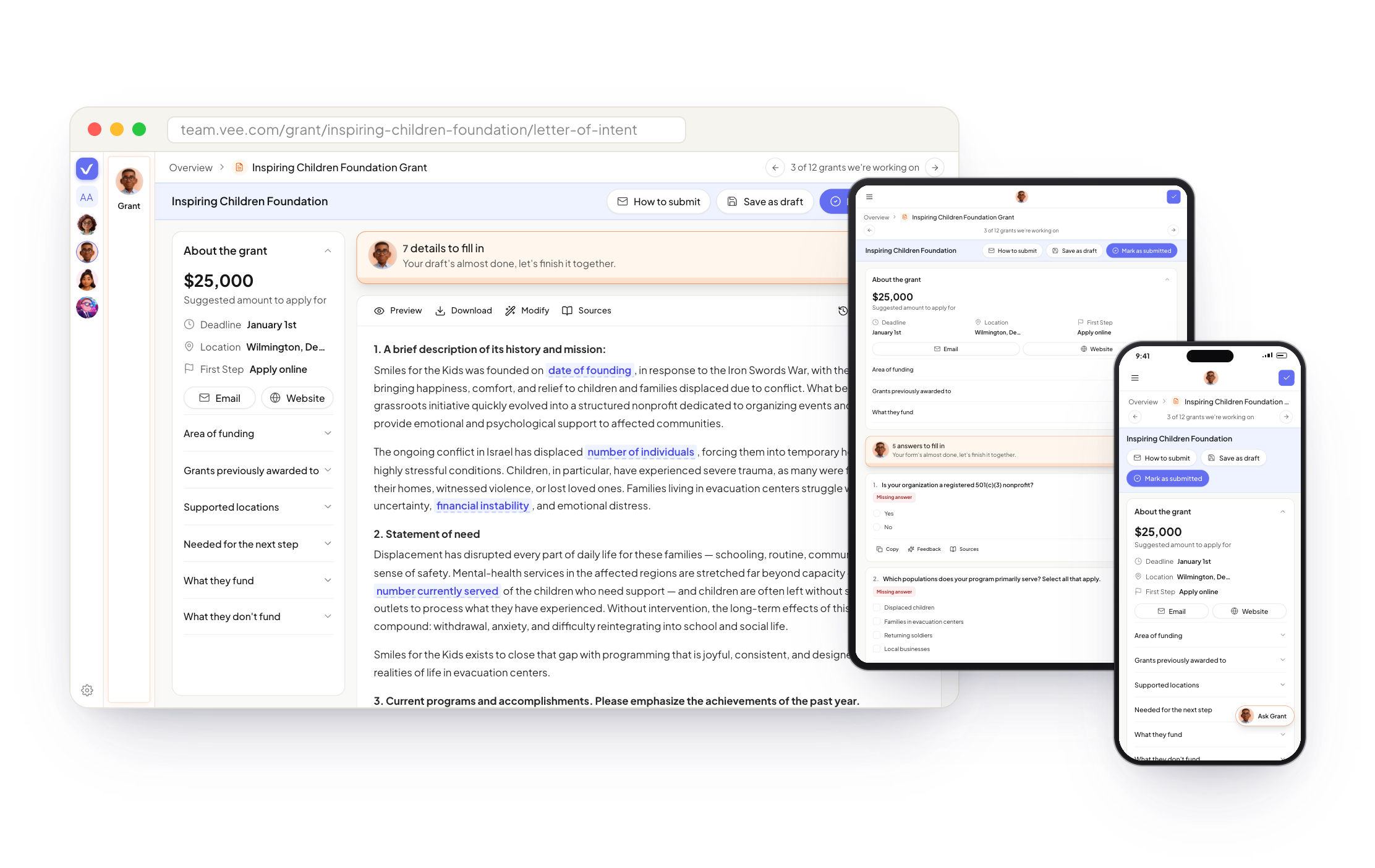
Desktop. The funder’s criteria sit beside the letter, so checking a claim never means leaving the draft. Tablet. Chat becomes a drawer one tap away. Mobile. Reviewing and fixing details comes first, so the letter takes the screen.
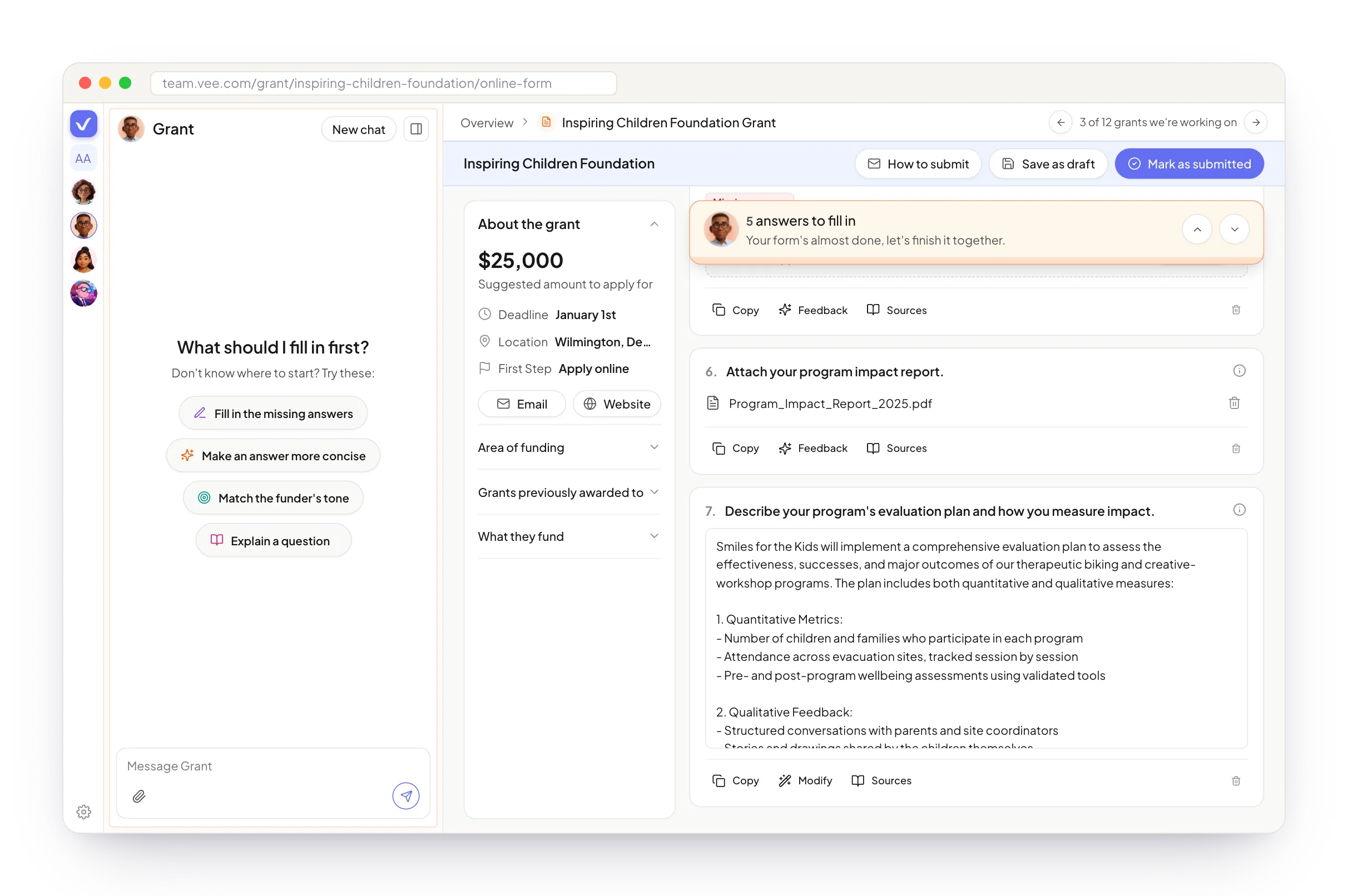
The first thing a reviewer needs from an AI draft is to know where it’s unsure. Grant marks every detail it couldn’t find inside the draft itself, and a counter steps you through them one by one — warming from orange to green as the draft comes together.
It guides, but never gates. The writer often knows a detail doesn’t apply, and a tool that overrules the expert stops being trusted.
I wanted the draft to admit where it was unsure before the user had to find it
Guidance, not a gate. Gaps are impossible to miss; the decision stays with the person.
This is the heart of the page. Every scope, from the widest to the finest: a letter is an argument, so Grant can rewrite the whole letter and keep it coherent; a form’s answers are independent, so you rewrite one answer without disturbing the rest. But most review isn’t wholesale — so the same AI edit goes all the way down to a paragraph, a passage, a single line. And under all of it, you can always just type.
Every scope works from both places: ask Grant in the chat, or work on the canvas — highlight and choose Modify, or modify a whole answer or the whole letter from its own button.
chat for when you can describe it; the canvas for when you can point at it
From the chat. A chat request is vague by nature, so Grant shows its work: a to-do list while it runs, tracked changes on the page, and a receipt specific enough to catch a misunderstanding before you keep it.
A passage, on the canvas. When you can point at the problem, pointing beats describing it.
Widest to finest. The whole letter, one answer, a passage, any line — or ask from anywhere.
The whole answer. Scoped to one question, so a rewrite can’t spill into answers you’ve already approved.
Even a chat request shows up on the page. Grant never moves you somewhere you didn’t ask to go.
“Updated the first paragraph of answer 7 to be shorter” — specific enough to catch a misunderstanding.
Tracked edits stay reversible, and anything you keep in the letter becomes a new version.
Visible, named, reversible — that’s what lets someone accept an AI edit without re-reading the whole application, and it’s where the time savings come from.
the rule I kept testing against: fix it at the size of the problem
Before you send, a short prompt reminds you that Grant can get things wrong — check names, dates and amounts. Naming the AI’s limits is what makes its strengths believable: calibrated trust, not blind trust.
admitting it can be wrong is how it earns the right to be trusted when it’s right
When the draft is ready, How to submit lays out the last steps for that funder — download the letter, copy the suggested email, send it from your own inbox — and Mark as submitted closes the loop so the outcome can be tracked. The process ends as clearly as it starts.
Today the send is the user’s. Submitting on their behalf is in the works — the next rung on the same ladder, earned by every step before it.
the end of the flow should feel as guided as the start
How to submit. Each step is handed over one at a time, then Mark as submitted starts the outcome tracking.
This workspace assumes the draft can be wrong and builds the exits in: versions you can always revert to, empty-document recovery when the funder’s questions aren’t published, a review-and-approve step on form answers, and reversible actions with undo.
Not “the model is reliable,” but “the model is probabilistic — here’s how you stay in control when it misses.” Every recovered miss is trust kept instead of trust lost.
Never a dead end. When the funder’s questions aren’t published, you add your own or switch to a letter.
every miss is a trust test — I made sure each one had an exit
Ask why a paragraph reads the way it does, ask for a change in plain language, highlight a passage and hit Modify — and watch the draft update in place.
go ahead, try to break it — that’s how trust gets tested
Grants are rarely one-and-done, and trust isn’t built in one application either. When you record an outcome, it feeds the next one; another step starts the next draft with the funder’s link, instructions and your documents carried forward.
That’s the loop the whole page is built around: every reviewed application and every outcome teaches Grant more about how this organization writes and wins, so the next draft needs fewer edits — and the user can trust it with a little more. The direction is autopilot, earned one application at a time rather than assumed on day one.
autopilot isn’t a switch you flip — it’s trust you accumulate
Recording the outcome is where one application becomes the next — so it takes a few taps, even on a phone.

Log the amount — it sharpens the next match.

No required fields — a rejection is the worst moment to ask for paperwork.

Next step + link, and the next draft begins.
The writing engine, built by the team, reads the funder’s questions, draws on the organization’s context and generates the draft. Everything from that draft forward was mine — the trust model, the review counter, the scoped rewrites from chat or canvas, the recovery states, and the submit-and-outcome lifecycle.
the engine writes; my job was making it worth trusting
That’s the time to get an application ready to submit, measured with PostHog funnels across the writing flow. The time didn’t come from skipping the review — it came from making the review fast.
The model could write a grant on day one. What took design was everything around it — making the draft easy to review, fast to fix, and honest about its limits — so that a nervous expert would trust it with something this important, and trust it a little more each time.
Trust isn’t a switch; it’s a ladder. The Writing Page is the first rungs — ease, speed and value, earned in the open. Autopilot is where it leads, and the only way there is to have earned every step before it.
the speed came from the review, not from skipping it