- Company
- Vee · Grant
- Role
- Product Designer & PM
- Team
- Me, engineering and AI engineers
- Outcome
- 60+ min → ~35 min to get ready
AI Grant Writing Workspace
How I turned “make the AI write better” into a workspace grant writers trust, and cut the time to get an application ready from 60+ minutes to about 35.
The problem
Getting a draft ready took longer than writing it.
Grant is Vee’s AI teammate for nonprofit grant writing. It drafts the Letter of Intent (LOI), or fills out a funder’s online form, grounded in the organization’s own history. The drafts arrived in seconds. Getting one ready to submit took grant writers 60 minutes or more of checking and fixing, so many gave up, or finished the job in ChatGPT or by hand.
Nobody handed me a spec. The ask was a problem: find out why people don’t submit, and fix it. I chose time-to-ready as the measure, because it captures the whole review, not just how fast the draft appears.
Is the draft good? Would they send it?
My role
Product designer first, PM where it moved the work.
The AI engineers built the writing agents and ran the evals. I proposed how we’d define good writing, and everything from the draft forward was mine: the grant writer office frame, the writing space, the review flow, the recovery paths, and the submit-and-outcome flow. Holding the PM role too let me make the calls design alone can’t: what ships, what waits, and how we’d know it worked.
From the Figma file
Every state, designed before it was built.
Empty documents, lost grants, tablet and mobile got the same care as the happy path - the unhappy states are where an expert decides whether to trust the tool.
Where it started
First, we made Grant a better writer.
The obvious fix was the writing. We made the agent stick to the organization’s knowledge, follow good grant-writing practice, understand each question, and match the client’s tone and voice. We also made the writing space easier to understand and operate.
But good writing is subjective. The articles disagreed, and so did the grant writers we hired to consult. So I proposed a broader test: 50 grant writers wrote the same LOI, and agents compared their drafts for shared practices. The AI engineers turned the findings into evals, the test sets the writing agents are scored against.
- 50grant writers each wrote the same Letter of Intent
- Patternsagents compared the drafts for shared practices
- Evalstest sets the writing agents are scored against
The turning point
Better writing didn’t make the review faster.
We had started a redesign in the same direction: more chat, more AI editing functions, auto-submit, new pages. Then customer success and sales calls kept raising the same thing, and session recordings showed it. Even with the better agents, people copied drafts out to ChatGPT or rewrote them by hand.
They didn’t trust the facts, and didn’t believe Grant could sound like them. More features wouldn’t fix that. I stopped the redesign and reset the goal: a draft people can check is worth more than a better one they won’t trust.
The reframe
Not a better editor. A grant writer office.
People needed Grant to feel like one product, a place they come to work with Grant, not a tool they paste from. I framed it as a grant writer office: a tracker of every grant, a hub for each one, and the writing space at the center.
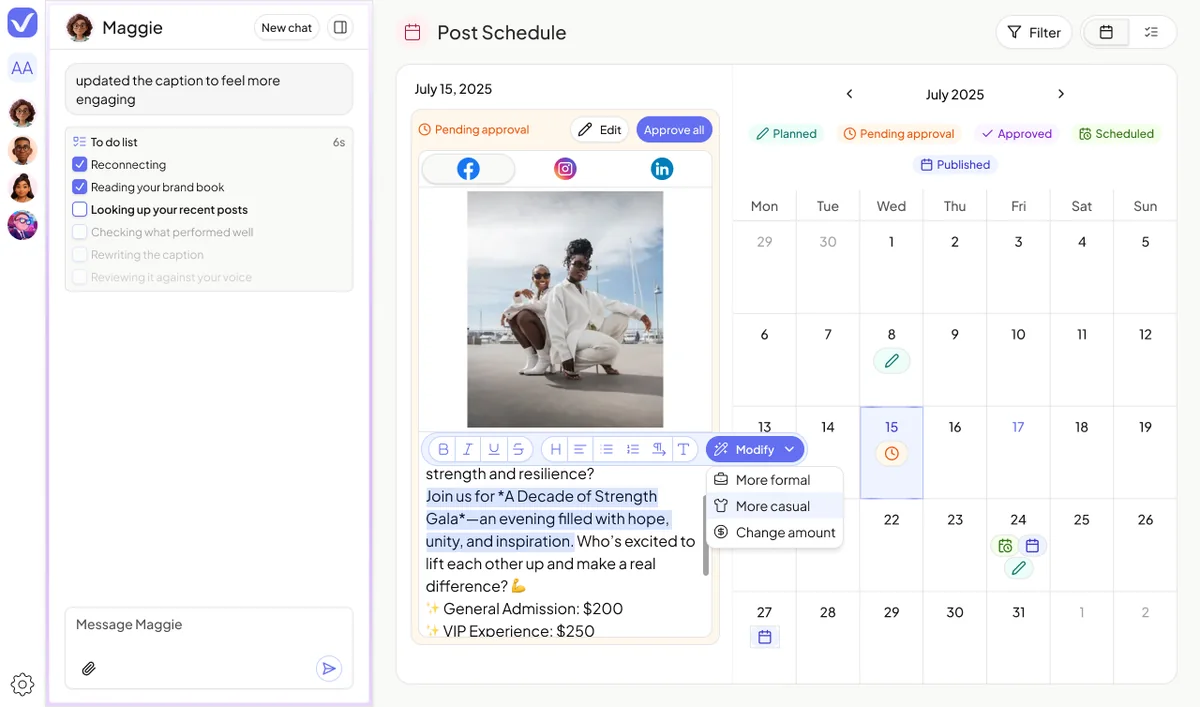
Inside the writing space, the Letter of Intent and the online form became one workspace. They share the funder sidebar, sources, versions, submission and outcome, and differ only where a letter and a list of questions must. Most people review over several sittings and devices, so it holds from desktop down to phone.
A call I made as PM
Auto-submit had to wait.
Leadership wanted auto-submit sooner. It’s the most visible step toward autopilot, Grant drafting and submitting on its own. I brought the recordings and the time-to-submit data: people were still spending an hour or more fixing drafts. They would never trust Grant to send one.
My argument: one badly submitted grant is worse than five badly written ones. We held it and fixed the review first. Submitting on the user’s behalf is now in the works.
Designing the review
Show what’s missing, and where to start.
Reviewers scanned a long letter for [placeholder] text, or scrolled 50+ form questions hunting for blanks. We explored several paths, some in parallel.
- ChecklistA list of “Question 1, 2, 3” gave no place to start.
- Sidebar checklist that jumps to each gapIt needed the model to name every question, which it couldn’t do well enough, and the page had no room for a sidebar.
- Inline highlights onlyYou see the gaps where you are, but not how many are left or where the next one is.
- Missing-count badgeYou know how many are left, but not where they are or how to get to the next.
- The counter (picked)Kept the best of each: gaps marked inline, a count, and one step to the next. It guides, but never gates, because a tool that overrules the expert stops being trusted.
Designing for the bad draft
The model will miss. Every miss needs an exit.
The model can get names, dates and amounts wrong, so before you send, a short check names exactly those. Naming its limits is what makes its strengths believable.
Every edit is scoped to what you select, shown as a tracked change, and reversible. So when a draft misses in a bigger way, there’s always a way out: add your own questions when a funder never published them, undo a rewrite, go back to an earlier version.
Outcome
60+ minutes, down to about 35.
The average time to get an application ready to submit, measured with product analytics (PostHog funnels) over 2 months across 200 applications. Alongside it: copy-outs to ChatGPT down 40%, editing time per draft down 35%, and drafts sent up 25%.
After submit
One application becomes the next.
The office doesn’t end at submit. Recording an outcome takes a few taps, even on a phone, and it feeds the next application. A lost grant asks for nothing, because a rejection is the worst moment to ask for paperwork. Next is per-funder learning: what each funder rewards, without losing the client’s voice.
 WonLog the amount - it sharpens the next match.
 LostNo required fields - a rejection is the worst moment to ask for paperwork.
 Another stepNext step + link, and the next draft begins.
Reflection
Agents are teammates. Teammates need trust.
Understanding how grant writers write, and getting the evals right, was a big step for the writing. But no matter how good the writing gets, the users are people. Vee’s bet is agents as teammates, and like any working relationship, that only works with transparency.
A better draft didn’t earn trust. A reviewable one did. And autonomy has to follow the cost of a mistake, which is why autopilot is earned, step by step.
Try it
Talk to Grant. The document stays yours.
Ask why a paragraph reads the way it does, ask for a change in plain language, highlight a passage and hit Modify - and watch the draft update in place. Switch between the two products to see one workspace hold both.